

My strength training for women over 40 at home came out of one long conversation: I’m 48, in perimenopause, here’s what I want to change about my body, here’s the garage, build me the routine that’s best for my age and my goals. What came back was 14 exercises over three days, hip thrusts at the center, protein as one number, and no training to failure. Then I built a tracker to run it.

This post contains affiliate links. If you sign up through one, I earn a commission at no extra cost to you. I only link tools I pay for and use. Nothing here is medical advice. I’m not a trainer, the program came out of a conversation with Claude about my body, and I’d run any of it past a doctor or a physio before copying it.
One thing up front, so the rest is honest: I built this at the end of July and I haven’t done a single session yet. I’ve been going to reformer pilates with strength training three times a week and it’s been blazingly hot outside, and stacking lifting days on top of a full week is the exact thing the program tells me not to do. It’s waiting for a cooler week with room in it. What’s below is what I asked for, what I got, and how it’s made.
Batwings, a stomach that sticks out, and a flat butt
Those are my words, from the day I built it. I gave Claude a list of what I wanted to change, and I was specific, because a vague goal gets a vague program. I also gave it my age, 48, and the fact that I’m in perimenopause, and asked for the routine that’s best for both. Not a generic plan with my name typed at the top.
Arms first. The backs of them have gone soft, and pilates is helping slowly, but I wanted something direct. I also want thin and toned, not big, which changes the answer. Stomach second. It sticks out, and I suspect it’s a form thing from class rather than just a fat thing, so the fix is core work with the ribs down. Butt third. Flat, and I’d like it bigger and higher.
Then the fourth one, which I put on the list and got an honest answer about. My inner thighs touch now. They didn’t used to. I wanted them not to. Claude told me that’s fat distribution, not something a muscle exercise changes, and no program can promise it. So the program does the only truthful thing it can: it measures the thigh with a tape every few weeks and never gives me an exercise for it. That’s a rule now. No inner-thigh work, ever. Measure it, leave it alone.
Three goals got an exercise each. One got a tape measure and the truth.
What’s in this strength training plan?
Mine is 14 exercises over three days a week, 30 to 40 minutes each, built around the lifts that grow glutes and the ones that make a waist look smaller by making the shoulders and back wider. Every session has the same warm-up, every set stops short of failure, and the whole thing runs on dumbbells, a barbell with no rack, a bench and a mat.
My four goals turned into this:
| Goal, in my words | What the program gave it |
|---|---|
| Batwings, thin and toned, not big | Seated overhead triceps extension, two light sets of 12 to 15. Direct work, no bulk |
| A stomach that sticks out | Dead bug, ribs down, slow. Plus side plank, because heavy oblique work makes a waist blocky |
| A flat butt | Barbell hip thrust three times a week in three versions, Romanian deadlift, split squats, step-ups, side-lying hip abduction for the lift |
| Inner thighs | Nothing. Tape measured every few weeks and left alone |
The split is roughly 60% glutes and lower body, 40% back, shoulders and core, which is the hourglass math. Day A is glutes and push, Day B is hinge and pull, Day C is glutes and an upper mix. The overhead press is in there because shoulder width is waist contrast. The one-arm row is in there because lats are the V that makes a waist. I didn’t know either of those going in.
Then the age part:
- No training to failure. I’d been told you have to. I asked, and the answer was no: stopping two to three reps short builds the same muscle with a fraction of the recovery cost. Every set in the program stops there.
- Long rests. Two to three minutes on the big lifts. No supersets, no circuits, no finishers.
- Protein as one number. 100 grams a day, worked out from my bodyweight. Not macros, not an app. One number on the dashboard.
- Balance in the warm-up. A single-leg stand, 30 seconds a side, every session, because my balance test scores are bad and that’s trainable.
- Six weeks of the same moves. Weeks one and two are two sets and deliberately easy. Three and four go to three sets. From week five, a weight goes up only after two clean sessions at the top of the rep range. Reps first, weight second.
- Tape, not scale. Hips, glutes, waist, shoulders and arm every two to four weeks. Bodyweight is an optional field, “just for the heck of it,” drawn as a faint line so muscle showing up never reads as failure.
And no bands anywhere, because I hate bands and I built the thing.
Who is a strength training plan for women over 40 for?
It’s for one person in her forties or fifties with a limited energy budget who wants to build muscle a few times a week without wrecking the rest of the week doing it. Dumbbells, a bench, a barbell with no rack, a garage. If you’ve been handed a plan that assumes you’re 25 and can train to failure four days a week, this is the other thing.
It isn’t for everyone, and four groups should use something else:
- Anyone chasing PRs or fast progress. The first six weeks repeat the same movements on purpose, and every quest about weight is locked until week seven. If you want to add weight every session, this will annoy you by Wednesday.
- Anyone who needs a gym or bands. The program is dumbbells, a barbell and a mat. There’s no machine work and no band work.
- Anyone with scale or photo goals. There are no progress photos and no target weight. The tape is the progress.
- Anyone who wants a program from a coach. The 14 exercises came out of my goals and a conversation with Claude, not a trainer. It’s a limit worth saying out loud.
What do you need to build a strength training plan with Claude Code?
You need the conversation, a place to keep the program and the log, a page to run a session from, and a garage. Mine cost nothing new.
| Tool | What it does here | Free or paid |
|---|---|---|
| Claude Code | Wrote the program from my goals and my age, then built the page and the rules. I decided what it does, it wrote the code | Paid, my existing plan |
| Airtable | Holds the five tables: Exercises, Sessions, Sets, Measurements, Game State. The source of truth | Paid, on the plan I already had |
| Cloudflare Workers | Serves the page and proxies the Airtable calls so the key never touches the browser | Free tier |
| A phone and a garage | Where the session actually happens | Already owned |
| Dumbbells, a bench, a barbell | The whole equipment list. No rack | Already owned |
How does the strength training plan and tracker work?
A session starts with one number and ends with a walk, and the page makes every decision in between so I don’t have to. I tap my energy, one to five. I worked out what my numbers actually mean by tracking my energy first. Three or above gets the next day in the rotation with a suggested weight per exercise. One or two gets a 15-minute version with three lifts and a walk, and it counts in full. That’s the same move I wrote about as shrinking the seed.
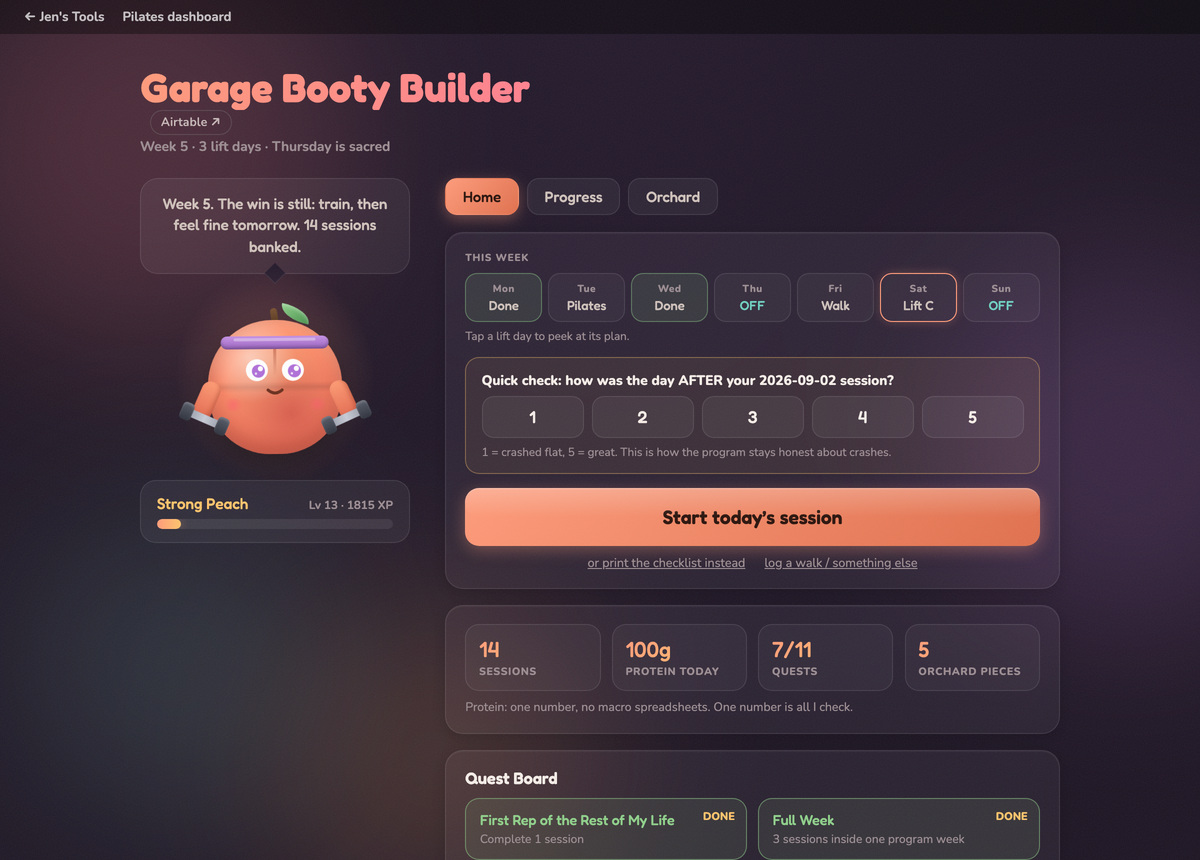
That’s the home screen with demo data in it, since mine has none yet. The week strip is Monday, Wednesday, Saturday for lifting, with Tuesday already taken by a Pilates class I track in its own base and Thursday marked off, because my energy dips mid-week and I’ve got the data to prove it. The card in the middle is the next-day check.
| The page does this on its own | I do this |
|---|---|
| Serves the next day in the rotation, A then B then C. I never pick. | Tap an energy number before I start. |
| Suggests a weight per exercise from the last two sessions. Adds the smallest step only when both hit the top of the rep range and felt right. | Log each set. Weight, reps, and whether it felt easy, right or too hard. |
| Starts the rest timer after every set, and the cool-down timer at the end. | The day after, answer one question: how was today, one to five? |
| Refuses two lifting days in a row. Refuses Thursday. | Every two to four weeks, a tape day. |
| Marks a session as a crash if the next-day answer is one or two, and repeats the previous weight next time. Two crashes inside 14 days: proposes an easy week. Every seventh week: an easy week on the calendar, weights down 30%. | Accept or skip the easy week when it proposes one. |
| Keeps score. Points for showing up, warming up, cooling down and tape days. No streak anywhere, so a missed day is invisible. | Nothing else. |
Each exercise on the plan has a video link, too. There’s a Video URL field on every exercise row for a form video I pick myself, and until I’ve pinned one, the link opens a search for that movement’s proper form instead of a guessed URL. I haven’t pinned any yet.
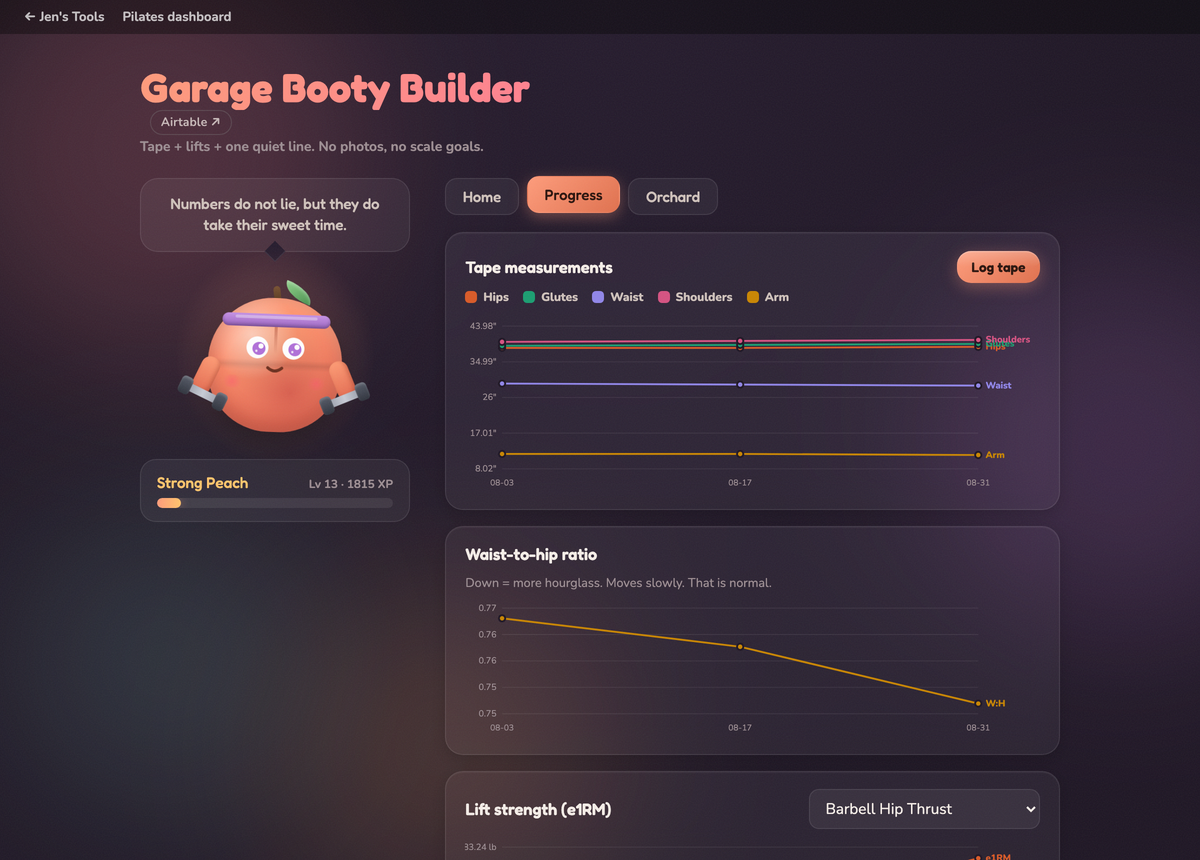
The Progress tab is tape and lifts, with demo numbers. Five tape lines, a waist-to-hip ratio, and an estimated one-rep max per key lift. The chart copy says the strength line is allowed to stay flat for six weeks, because it is.
There’s a peach named Georgia in the sidebar who grows through five stages as the points come in, and an orchard that adds one piece per week I trained. And the Sunday health email I already get, the one my Apple Health sync feeds, reads these tables too. On a week with no sessions it says nothing.
Get the skill
Mine is shaped around 48, perimenopause, four specific goals, three days, and a barbell with no rack. Yours is a different body with a different list, so the tool below asks about yours. Say your age range and stage, pick what you have to lift, how many days your energy allows, what to work on and what’s never allowed, and it writes a build prompt for Claude Code that plans your program and the tracker to run it. If you want it, it also writes a coach skill that runs a session from the chat once the tracker exists.
The first question the prompt makes Claude ask is whether a doctor or physio has cleared you to lift. That’s the one step I won’t let it skip. Not medical advice, and it doesn’t know your history.
What it doesn’t do
Three things I’d change, all still true today.
Six weeks of the same moves gets boring. That’s on purpose, because the first six weeks exist to prove I can train without paying for it, and you can’t prove that while changing the variables. The fix is designed and not built: at every seventh-week easy week, swap the accessory exercises for variants and keep the key lifts. Boredom is a real constraint for me, so this one moves up the list the day I start.
The program only edits in Airtable. The page reads the 14 exercise rows and can’t change them. Tuning the program means opening the base. Fine for me, since I like the base.
Thursday and Tuesday are hardcoded. The week strip is built around my class day and my bad day. Moving them is a code edit right now, not a setting. The generator above makes both an input, which is me fixing it for you before I’ve fixed it for me.
Frequently asked questions
What should strength training for women over 40 include?
Mine includes progressive lifting that stops short of failure, long rests, a daily protein target as one number, balance work in every warm-up, and progress measured by tape rather than scale. That came from telling Claude my age, my stage and my goals. Ask a doctor or a physio what yours should include.
Do you have to train to failure to build muscle?
No. Stopping two to three reps short builds comparable muscle with far less recovery cost, which is why every set in my program stops there. I’d been told the opposite and asked directly.
What is a low-energy workout session?
A 15-minute version of the day served when I rate my energy one or two out of five. Warm-up, three lifts at 90% of the last weight, two sets each, then the cool-down walk. It earns the same credit as a full session.
Can I build this without Airtable?
Yes. The program and the rules are the build, not the database. A spreadsheet with the same five tabs works. Airtable is what I already pay for, and its API is what the page reads.
Is this medical advice?
No. It’s a personal program built from my goals, my age and a conversation with Claude, and it knows nothing about your health. Talk to a doctor or a physio before starting a lifting program, and stop any movement that hurts.
Try it yourself
Write the list before the program. What you want to change, in your own words, plus your age and where your body is right now. Then ask for the routine that fits all of it, and make it explain what it changed because of your age. If it can’t say, it wrote a generic plan.
A tool I built
Energy Battery
Log your energy through the day and watch your battery fill, so you can see what actually charges you and what drains you.
Find your spark →I run an affiliate program on the tools I build. Approved affiliates earn 20% on what their referrals pay, for up to a year. US only for now. See the program →
Related reading
- My Pilates Progress Tracker: 79 Classes, 24 Moves, One Base
- How I Sync Apple Health to Airtable, Right Next to My Food and Mood Log
- Software Subscriptions I Canceled Because I Built My Own
- I Built a Meal Planner App to Save Recipes From Websites
Subscribe if you haven’t already, there are more of these builds on the way, and in the meantime, go forth and automate the boring stuff.