

I canceled about $310 a month in software subscriptions over the past year and replaced them with tools I built myself. My software bill didn’t go down. It went up, because building your own means paying the AI doing the building and then maintaining the result forever. I’d make the same trade again, for a reason that has nothing to do with money.

Some links in this post are affiliate links. If you sign up through one, I earn a commission at no extra cost to you. I only link tools I pay for and use.
QuickBooks went the day the blog did
I had QuickBooks because I was incorporated. A corporation has to run payroll, and payroll was the job I was paying $131.50 a month for. The bookkeeping came along with it.
Then I sold that blog last year and set up as an LLC, and an LLC with no employees doesn’t run payroll. The job I was paying for stopped existing, so I got rid of QuickBooks right then and built my own bookkeeping system to replace what was left.
Then I did my blog analytics. Then a third one, a fourth, and by the seventh I had to admit this had stopped being a cost decision and turned into a hobby. Somewhere in there I learned the hard way that the subscription was never the expensive part.
What software subscriptions did I cancel?
Seven, over about a year. Below is every one with what I actually paid, pulled from my own books rather than from anybody’s pricing page, because a pricing page has never once told me the truth about my own bill.
| Tool | What I paid | What replaced it | Status |
|---|---|---|---|
| QuickBooks | $131.50/month | JBI Books, my own bookkeeping system | Built and running |
| Nifty AI | $69.99/month | Mine, in progress | Canceled, still building |
| Clariti | $45.00/month | My own blog analytics dashboard | Built and running |
| Flodesk | $19.00/month | Mine, in progress | Canceled, still building |
| Tailwind | $29.99/month | My own pin and scheduling system | Built and running |
| Canva | $119.40/year | Many Claude Code skills that resize and handle images | Not renewing |
| Toby | $54.00/year | My own tab and link organizer | Built and running |
Two of those seven have no finished replacement yet. I canceled Nifty AI and Flodesk before the thing meant to replace them existed, which is a decision I’d describe as optimistic. The Canva one is the softest of the group. I haven’t canceled it, I’ve decided not to renew when it comes up, so I’m still paying for it as I write this.
The one I’m proudest of is Clariti at $45 a month. I liked Clariti. I didn’t leave because it was bad, I left because I wanted the same reporting shaped around my three blogs specifically, and I’d have happily kept paying for it once those blogs started earning.
Tailwind at $29.99 a month is the one I actually missed, and I missed it right when I started the new blogs and wanted it most. That’s also exactly when I couldn’t justify it. Paying thirty dollars a month to promote blogs earning nothing yet is a hard sentence to say out loud, so I built my own pin and scheduling setup instead. Toby was the easiest of the seven at $54 a year, a tab organizer I replaced and haven’t thought about since.

Why didn’t canceling five subscriptions lower my bill?
The version of this post where I saved $275 a month would be a better story and a worse one.
That $309.93 a month is gone. My AI spend is $395 a month, made up of a Claude Max plan at $200 plus API bills for Anthropic, OpenAI and image generation. My total software bill runs $583 a month, and I broke every line of it down in my post on what my blogging stack costs.
So I removed $310 of subscriptions and added $395 of AI. You don’t need my calculator for that one.
Somebody on X got there before me, and put it better.
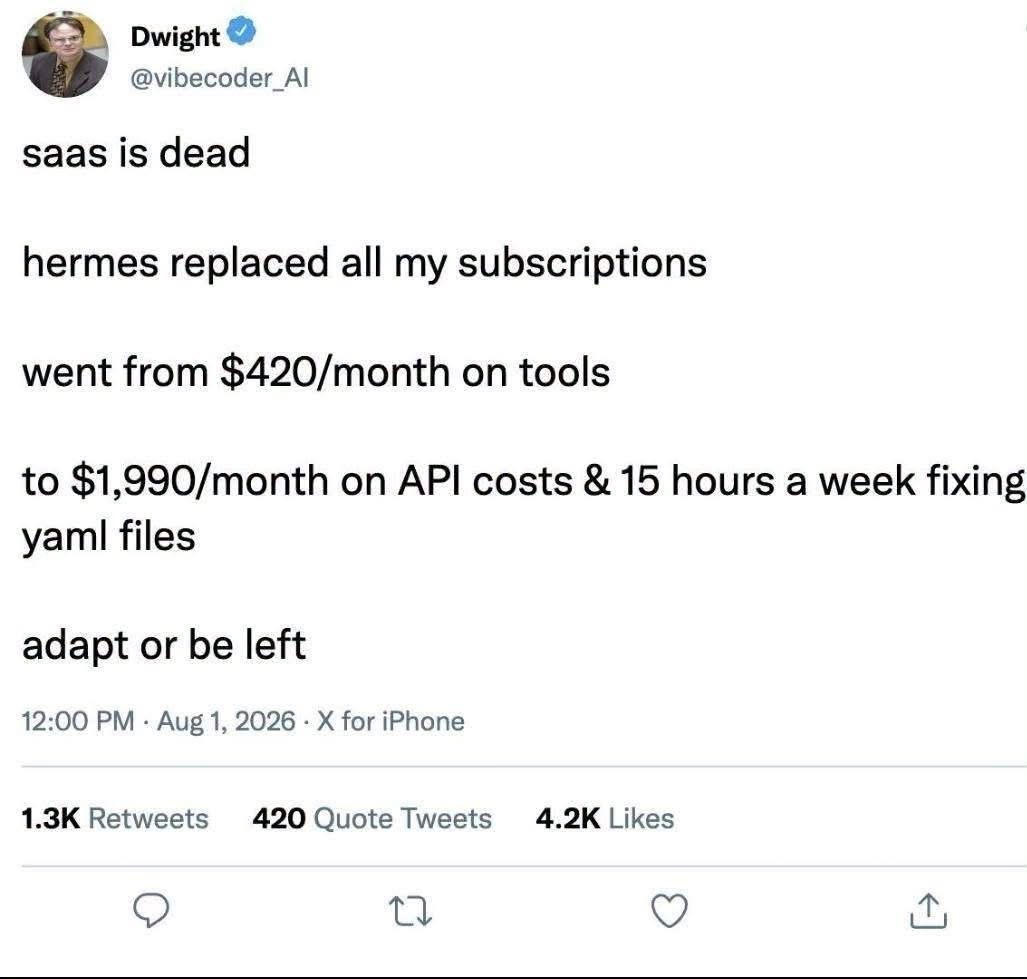
That’s a joke account, and the numbers are made up. I’m also pretty much living it.
The AI line does far more than run those five replacements, so it isn’t fair to put the whole $395 against them. It’s also the reason I can’t stand here and tell you building your own is the frugal option. It wasn’t for me.
Then there’s the part with no invoice attached. Every tool I built is a tool I now maintain. When my books system breaks there’s no support email, no chat widget, no cheerful person named Angela asking me to clear my cache. It’s me, at whatever hour I notice, and the on-call rotation is one name long. I swapped a monthly charge for a permanent low-level responsibility, and unlike a subscription it never comes up for renewal. It just sits there being mine.
What the trade bought me is control. JBI Books does what my business needs instead of what a product manager decided the average small business needs. I wanted a field, so I added a field, on a Tuesday, without submitting it to a roadmap and waiting two years. That’s the whole return, and for me it’s plenty.
What I didn’t try to replace
Two tools I pay for on purpose, for two different reasons.
OINK for Influencers is a browser extension for Amazon Influencer work, and it matches products to Creator Connections campaigns. I’m not attempting this one. Rob (Fizz) ships new features constantly and the thing does a job I want done rather than a job I want to think about. Some tools you use, and this is one of them. Plus, there’s an awesome community attached. If you want to try it, the code JENNIFER takes 10% off.
RoboForm is my password manager at $29.88 a year, and it’s a hard no on rebuilding. Not because it’d be difficult. Because the failure mode is every password I own, and I don’t want to be the sole maintainer of that. Some things you should not own the risk on, and a home-built credential store is top of the list.
Those two reasons are different and both are real. One is about a vendor doing it better, one is about blast radius. Neither is about the price.
Build your own audit
I’m not handing you my audit, because my rules are mine. I won’t let anything near my passwords and I have an unreasonably high tolerance for maintaining my own mess. Yours will be different, and a checklist built around my nerves is no use to you. If you’d rather start with pen and paper, I wrote a 10-minute subscription audit on my other blog that needs no tool at all.
So build your own. Five questions, and it writes you an audit shaped by your answers. Nothing you type leaves the page.
Not loading? Open the generator in a new tab.
Don't fudge question four and it'll tell you to keep paying for more of them than you expected. Mine did.

Where this breaks
The generator asks how much you like building things, which helps, but it takes your word for it. I'd have told you 180 hours a month with a completely straight face.
It's also bad at partial replacements. My Canva situation isn't a clean swap. I replaced exactly one job Canva did, resizing images, with a small skill. Canva does a hundred other jobs I stopped needing, and an audit treats a tool as one unit when a subscription is usually a bundle wearing one price tag.
And the maintenance number is a guess. Mine has been wrong in the same direction every single time, which is low. Whatever hours you write down, double them and you'll be closer than I was.
Frequently asked questions
How much did canceling those subscriptions save me?
Nothing. The seven came to about $310 a month and my AI spend is $395 a month, so my total software bill went up rather than down. What changed is control over how each tool works, not the amount I pay.
What should I never replace with something I build?
Password managers and anything storing payment credentials. The failure mode is too severe and you'd be the only person on call. Financial records sit one step below that, replaceable but only if you have a real plan for exporting your data when you need it.
Do I need to know how to code to build a replacement?
No, and I didn't write the code by hand for any of these. I build with Claude Code, which writes and runs the code while I decide what the thing should do. You do need to be willing to maintain what comes out the other side.
How long does it take to replace a subscription?
My bookkeeping system took the longest by a wide margin. The image resize skill took an afternoon, and the tab organizer took less than that. The gap between those is the real answer: single-job tools go fast, and anything holding your data does not.
Why keep paying for anything if you can build it?
Two reasons beat building. When a vendor ships features faster than you'd get to them, paying buys their roadmap. And when the failure mode is bad enough, like every password you own, you want somebody else holding it at 2am.
Try it yourself
Run the generator, give it real answers, then point the audit it writes at your own subscription list before your next renewal. Expect a couple to come back as KEEP, because a self-built replacement costs API fees plus your own maintenance time rather than nothing. And for the ones you do cancel, I built Subscription Graveyard to keep score. You bury the subscription, it gets a tombstone, and the running total of what you're not paying anymore climbs.
If you want to take the file it writes and keep shaping it, that's the same habit I wrote about in how I customize Claude Code skills instead of installing them.
A tool I built
Subscription Graveyard
Bury the subscriptions you've canceled, give each one a tombstone, and watch what you're saving pile up.
Bury your first one →I run an affiliate program on the tools I build. Approved affiliates earn 20% on what their referrals pay, for up to a year. US only for now. See the program →
Related reading
- My Software Bill Is $583 a Month. The Blog Is $328.
- I Don't Install Claude Code Skills, I Customize Them
- What a Claude Code Skill Is, and How to Make One
- I Built My Own Link in Bio Tool and It Lives on My Blog
That's Part 5 of Claude Code for Bloggers. Subscribe if you want the rest, and go look at what renews next month before it renews itself.