

I have million-idea brain. One minute an idea is the best thing I have ever thought of. Five minutes later I am poking holes in it. I have been known to fully kill a project in my head over coffee, restart it before lunch, and shelve it again by dinner. Brainstorming alone stopped working for me a long time ago, because I lose the plot somewhere between voice #1 and voice #2 in my own head.
So I built an AI brainstorming panel in n8n, a workflow with 7 other voices in it.
The Brainstorming Bunch is an n8n workflow with one form on the front and 7 AI personalities behind it. I drop a business idea in, answer a handful of questions, and in about 3 minutes an email arrives with 7 distinct takes on what I submitted, ending with a verdict and one specific action I can take this week. The workflow runs on my own n8n instance, so this isn’t a public form to use, but the generator at the end of this post builds you your own version, voices and all.
Shark Tank was a tiny bit of inspiration when I sketched it out, but the Bunch isn’t modeled after them. I built it to hear from voices I wouldn’t have invited to my brainstorm, because I don’t always know I need them.
This post contains affiliate links. If you sign up through one, I earn a commission at no extra cost to you. I only point to tools I actually use or would recommend.
The 7 voices on the panel
Each one is its own AI prompt with its own personality, its own brief, and its own format (3 short bullets each). I tuned them over a few rounds to keep them distinct.
| Voice | What they bring |
|---|---|
| ⚖️ Legal Eagle | 3 things you need to know or do, in plain language, no lawyer talk |
| ⚠️ Devil’s Advocate | 3 hard truths a sharp, kind friend would tell you over coffee |
| 🚀 The Optimist | 3 specific reasons the idea works, backed with reasoning (not just cheering) |
| 💰 Money Maven | 3 numbers-based reality checks: costs you forgot, math doesn’t pencil out, or how the model can pencil out |
| 👥 Voice of the People | 3 reactions from someone who’s heard every “I’d totally use this” from friends who never bought a thing |
| 🧭 Conscience Keeper | 3 considerations on who might get hurt, reputation risk, what to watch as the thing grows |
| 🧠 The Mastermind | Final verdict, the single most important takeaway, and one specific action for this week |
The Mastermind goes last on purpose. By the time it weighs in, it has the other 6 takes to consider.

What the form asks
The form takes about 90 seconds to fill out:
- Your name and email (so the report comes back to you)
- The business idea, in your own words, in as much detail as possible
- Who the target customer is
- How you plan to make money
- What stage you’re at (idea, MVP, launched, scaling)
- Estimated startup budget (a dropdown ranging from none up to $25k+)
- Relevant skills or experience (optional)
- Your biggest concern about the idea (optional)
The more context you give, the sharper the panel gets. The two optional fields at the bottom are the ones I’d argue pull the strongest responses, because the panel has something concrete to react to instead of generalities.
How does the AI brainstorming panel work behind the form?
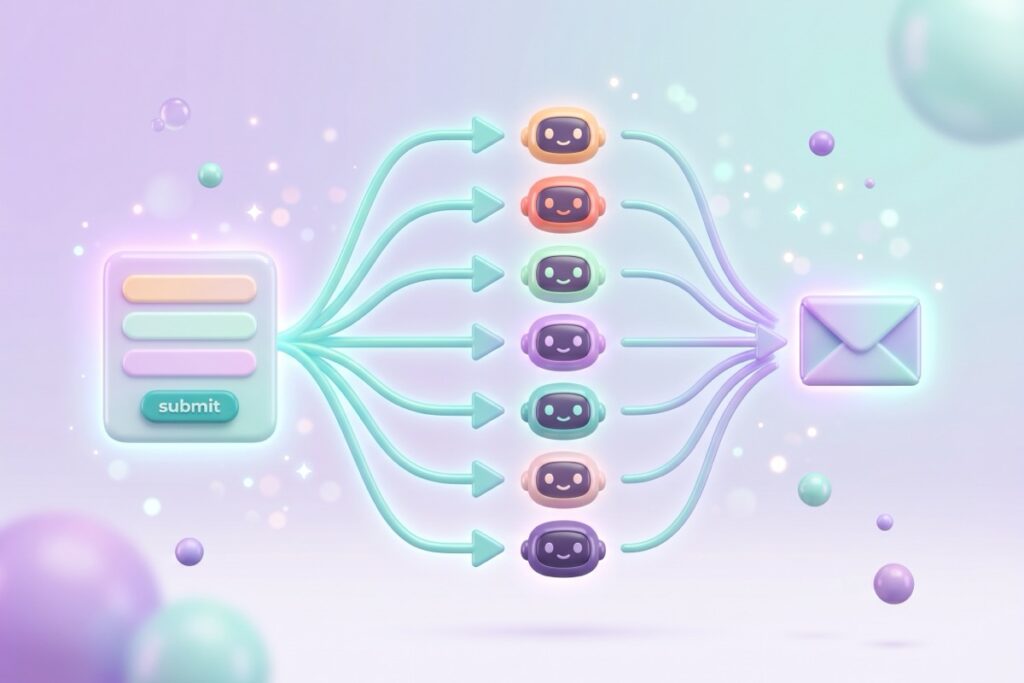
The workflow has 12 nodes and runs like this:
- Form trigger captures every input
- Store Idea holds your submission as a clean object the AI nodes can read from
- 7 AI calls in parallel, each personality is its own OpenAI node (gpt-4o), with the same input but a completely different system prompt
- Assemble Email combines all 7 responses into a single branded HTML email
- Parse Email cleans up the formatting
- Send Report delivers it via Gmail
Total runtime: roughly 3 minutes from form submit to email landing. Most of those minutes are the parallel AI calls thinking.
The parallel part is the design choice worth calling out. If the 7 personalities ran one after the other, you’d wait closer to 12 minutes. n8n branches them at the form output, all 7 calls run at the same time, and then they re-merge before email assembly. It’s the same fan-out pattern I used in my crypto sentiment analysis tool.
What it feels like to get the report back
The first idea I ran through it was a business idea I’d been sitting on for a few weeks. Three minutes after I hit submit, an email sat in my inbox with all 7 takes laid out cleanly.
The Optimist said something close to what I’d been telling myself. Money Maven flagged a cost I’d been hand-waving past. Devil’s Advocate named a worry I’d had silently but never said out loud. The Mastermind tied it together and gave me an action for the week, not a vague “do more research.”
It was the first time brainstorming told me something I didn’t already know.
The entire point is this: I’ve already heard the optimist in my head. I’ve already heard the doomer in my head. The voices I haven’t heard are the ones who know things I don’t, the lawyer, the CFO, the customer who’s been pitched everything. Those are the seven voices on the panel.
If that stuck-on-the-next-step feeling is familiar, even without a business idea attached, I wrote about working through it in how to stop feeling stuck over on Seeding Serendipity.
Want to pressure-test your own idea?
You can’t use my panel directly, but I built a lighter version you can. Answer a few quick questions and the seven voices each hand back the sharpest question they’d ask about your idea, plus a readiness score and one move for this week.
Frequently asked questions
How does AI brainstorming compare to brainstorming with humans?
AI brainstorming is faster (3 minutes vs scheduling a real call), available at 11pm on a Tuesday, and gives you distinct angles you can dismiss in writing without offending anyone. It’s worse at picking up on what you don’t say out loud, and it can’t read a room. Best use: solo idea pressure-testing in the planning stage. Once an idea is real, talk to humans too.
What AI models does the Brainstorming Bunch use?
All 7 personalities run on gpt-4o. I picked gpt-4o because each personality has a specific style and structure, and gpt-4o holds character better than smaller models. Cost per full panel response runs roughly 8-12 cents depending on input length, paid out of my n8n instance. These days I use Claude more, so I might consider switching at some point.
Can I customize the AI personalities?
Yes, each personality is its own OpenAI node with its own system prompt. Swap out the prompt, get a different voice. Mine stay business-oriented because business decisions are what I built it for, but you can rebuild this for creative projects, content ideas, hiring decisions, or anything where multiple angles help.
Can I use the Brainstorming Bunch myself?
The form isn’t public, since it runs on my own n8n instance for my own ideas right now. But the generator in this post builds you your own version: pick your voices and it writes a Claude Code skill that runs the panel in chat, plus a prompt that builds the n8n workflow.
What kinds of ideas work best for this?
Business ideas, product launches, side hustles, and anything you’re considering investing time or money in. The current form asks business-shaped questions (target customer, monetization, startup budget), so creative or non-business ideas are a stretch on this version. A v2 for content and creative decisions is on my list.
How long does the panel take to respond?
About 3 minutes from form submit to email delivered. Most of those minutes are the parallel AI calls running. Once the AI is done, the email is instant.
What I’d build into v2
Things I’m noting as I use it more:
- Save every response to Airtable so I can pattern-match across ideas over time
- A “push back harder” option where you ask one personality to challenge their own first response
- A non-business variant for content ideas, creative projects, life decisions
- A web UI instead of just email so the report shows in the browser too
Some of these will happen. Some won’t. The shipping rate is on-brand for me too.
Want to build your own version?
Right now the Brainstorming Bunch lives on my own n8n instance, which means it’s running for my own back-burner ideas rather than as a public form. I’m not ready to take on other people’s API bills, and part of the fun is keeping this one as a personal thinking tool while I keep tuning it. If you build your own, you’ll need somewhere to run n8n, and I self-host mine on a Hostinger VPS.
Once you’ve got a workflow like this running, here’s how I back up every workflow automatically so a bad edit never costs me one. And if you want to go deeper on building stuff like this, the AI Automation Society Plus is a Skool community built around n8n and Claude Code, the exact toolkit behind this workflow.
If you’re working on a new automation idea and not sure whether the build time pays back, the Automation ROI Calculator is the natural next stop. It runs the math before you open n8n.
If your head is as full of ideas as mine usually is, it helps to sort them down before you pressure-test one. Here’s how I turn a pile of ideas into plantable seeds.
Get your own brainstorming panel skill and prompt
Pick the voices you want weighing in and what each one hands back. This builds both pieces: a Claude Code skill that runs your panel right in chat, and a prompt that has any AI write the n8n workflow version like mine.
If you think out loud in circles like I do, an AI brainstorming panel gives you seven outside angles and one clear next step in the time it takes to make coffee.
Subscribe if you haven’t yet, and in the meantime, go put one of your back-burner ideas in front of the bunch.
A tool I built
Build a Bio
Build a branded link in bio page in about a minute, then embed it on your own blog so your clicks land on your site, not someone else’s.
Build your bio →I run an affiliate program on the tools I build. Approved affiliates earn 20% on what their referrals pay, for up to a year. US only for now. See the program →